
Prop firms
Prop Firm Copy Trading Rules: Self-Copy vs Third-Party
Copying your own trades between your own accounts is allowed almost everywhere. Copying anyone else's gets the account closed. Here's where firms draw the line, and how they see it.
Two traders at the same firm, running the same copy setup, one gets paid and one gets terminated. The difference isn't the software. It's whose account the trades came from.
Most forex prop firms allow copy trading between accounts you own, including accounts at other firms, and FTMO, FundingPips and Alpha Capital say so on their own pages. What they prohibit is any arrangement where trades from someone else's account land in yours, or yours land in theirs. The rules are written around ownership, not technology, and firms detect the difference from the trades themselves.
Rules below were checked on each firm's own pages on 14 October 2026. They change often, and the firm's page is the only version that counts.
The one line every firm draws
Your accounts, copied between themselves: allowed. Anyone else's account, in either direction: not.
The reason is the same one behind every prop firm's EA rules. A firm's payout model assumes the funded traders on its book are making independent decisions. When one person's trades land in twenty accounts, the firm isn't funding twenty traders. It's funding one, twenty times, and all twenty win or lose together. Copying between your own accounts doesn't change that picture, because the firm already sized you as one trader with a capital cap. Copying from a stranger does.
Everything else in the rules follows from that.
What the firms actually say
Firm | Copying between your own accounts | Copying from or to someone else | The condition |
|---|---|---|---|
FTMO | Allowed, within the $400,000 maximum capital allocation per trader or strategy | Not permitted; holding accounts under separate registrations to get around the cap is also prohibited | Total capital across all your accounts stays inside the cap |
FundingPips | Allowed. "Copying trades between your own accounts in the same direction" is permitted | "Copy trading between different users' accounts is strictly prohibited" | Your FundingPips account as the master for an external copier is fine; use the investor password, since "using your main account password may trigger further investigation" |
Alpha Capital | Allowed under its copy-trading policy, on approval through support | Account management by a third party is listed as a prohibited strategy | Same strategy on two accounts counts against the $300,000 per-strategy cap unless trades open and close at different times |
Alpha Capital's definition is the one to read twice. Two $200k accounts trading EURUSD on the same signal are one $400k strategy, which breaches its $300k per-strategy limit. The same two accounts trading EURUSD with entries and exits at different times are two trade ideas. The firm defines a strategy by when it trades, not by what it's called.
How a firm tells self-copy from third-party
From the trades. Not from the software, and not from what you call it.
A risk desk compares accounts in pairs and counts how often their trades match inside a short window: same symbol, same direction, entries within a second or two, identical stop and target distances, lot sizes that are exact multiples of each other because they came from the same risk percentage on standard account sizes. Past a threshold, the accounts are one cluster. The broker's server also records how each order was placed, by hand on desktop, from mobile, from the web terminal, or by an Expert Advisor.
Self-copy produces that cluster. So does third-party copy. What separates them is who owns the accounts in it. If every account in the cluster is registered to you, you're inside the rules and inside your capital cap. If the cluster spans several registrations, the firm has found exactly what the rule prohibits, and it doesn't matter whether the trades arrived through a copier, a shared EA, a Telegram channel or a friend with your login.
That last case is the one traders underrate. Giving someone your credentials so they can trade your challenge is third-party account management, however you describe it, and it's the version firms terminate without discussion.
What a trade copier gets wrong on a funded account
A trade copier mirrors lots. Master opens 2.0 lots, every follower opens 2.0 lots, or a fixed multiple of it. That's the copy, and that's the problem.
Your $100k account and your $25k account have different daily limits, different drawdown floors, and often different rules entirely if they're at different firms. A mirrored lot that's reasonable on the first is four times too big on the second. The copier doesn't know, because it's copying a trade, not running a strategy.
Then there's the limit itself. A copier has no account-level view. If the master account hits its daily loss and stops, the followers stop too, but only because the master stopped. If a follower account is closer to its own limit, nothing stops it first.
Self-copy, done the way the rules describe
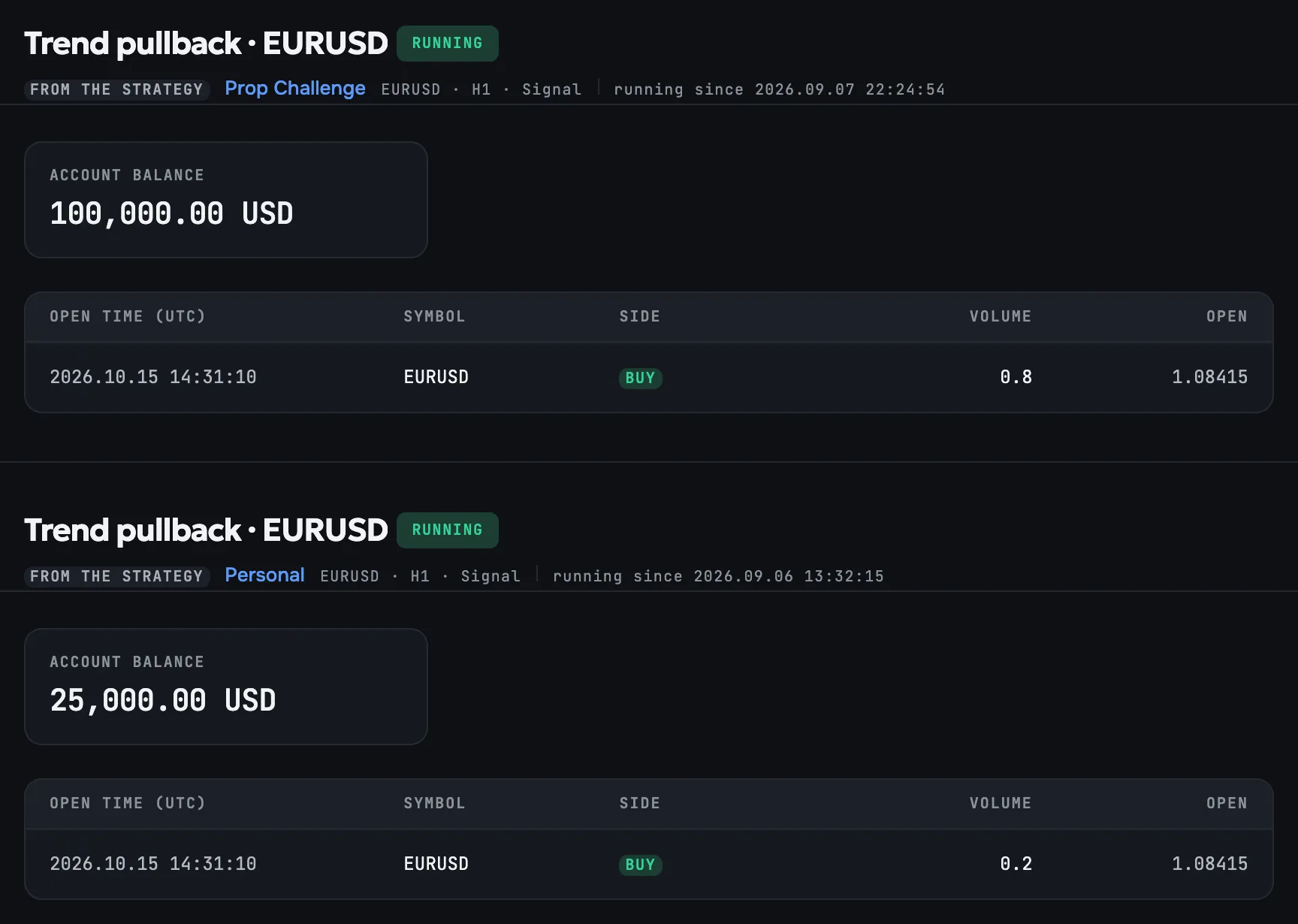
On Vectorhelm, you don't copy trades. You run one strategy on several of your own accounts, and each account trades it as its own.
The strategy defines size once, in terms that don't depend on the venue: a fixed amount per order, a percentage of balance, or a risk percentage against the stop. Each account turns that into its own order from its own balance, its own broker's contract size and lot step, and its own symbol name. Then two sets of limits apply on each account separately: the strategy's five (daily realized loss, daily realized profit, max drawdown, max open positions, max trades per day) and the account's five, with the day reset in that firm's timezone. The more restrictive limit wins, and a limit firing on one account never touches the others.
So two accounts running the same strategy don't carry identical lots. They carry whatever each account's balance and limits allow, which is what a firm's rules are asking for.
A strategy routes to any of your connected accounts: two at different firms, two at the same firm, or an MT5 account and a crypto exchange account together. Each route sizes in the venue's own units and uses the venue's own symbol name, so BTCUSD at the broker and BTCUSDT at the exchange are the same strategy. The one condition is that the symbol exists on both.
For signal providers
The question providers ask is how to let followers trade their signals without breaking the followers' prop rules. The answer is the same line the firms draw: distribute signals, not account access.
Vectorhelm never copies trades from one person's account into another's. A follower connects your signals as a source, TradingView alerts from your script or a Telegram channel, and runs their own strategy on their own account, with their own sizing and their own limits. You never touch their account and never see their credentials. Their account only receives orders that their own strategy and their own limits produced, which is the arrangement every firm's rule permits.
There is no feature to publish a strategy and mirror it into followers' accounts. That's by design, because that feature is the thing the rules prohibit.
The honest limitation
Self-copy inside a capital cap is allowed. Self-copy that pushes you past the cap isn't, and it's the easier mistake to make.
FTMO's cap is $400,000 per trader or strategy, across all accounts, before scaling. Run one strategy on three $200k accounts and you're over it, however many of them are yours. Alpha Capital's cap is per strategy at $300,000, and the firm counts two accounts on one signal as one strategy. Before you route a strategy to a second account, add up the capital it will trade and check it against the firm's number.
And firms don't publish where the detection threshold sits. Two of your own strategies that happen to enter on the same bar can look like one strategy to a review. Different timeframes and different entry logic keep them apart; a different name doesn't.
Before you connect a second account
Add up the capital the strategy will trade across every account, and check it against each firm's cap.
If the accounts are at different firms, read both firms' copy and EA rules. They differ, and the stricter one governs that account.
Use your investor password for anything that reads your account, never your main one.
Then run the strategy on both accounts in demo first and compare the lot sizes. If they're identical, you're copying trades; if they differ, each account is trading its own risk.
Join the waitlist. It's free, needs no card, and your invitation comes with a demo account running the full risk engine, so you can route one strategy to two accounts and watch each one size and limit itself before a real challenge is involved. Multi-account covers how routing works, and prop firm traders covers the limits.
Vectorhelm is execution software. It runs the rules you define on accounts you own and control. Nothing here is trading advice, and no configuration of risk limits prevents losses. Prop firm rules change; verify against each firm's own published terms before relying on anything here.
Opening soon
Automate it, with your limits built in.
Join the waitlist for free early access. Start on a demo account, then go live when you’re ready.
Join the waitlistStay informed
One email a month. Worth opening.
New articles and product news. No spam, unsubscribe any time.
A separate list from the early-access waitlist. How we handle your email.