
Strategies
TradingView Alert to DCA or Martingale: The Real Numbers
One setting turns a DCA ladder into a Martingale ladder. Here's what each costs at eight rungs, what bounce gets you out, and which limit actually stops it.
Every page selling a Martingale bot shows you the exit. The ladder goes underwater, the average entry drops, price bounces half a percent, the whole thing closes green. What none of them shows is the size of the position at the moment of that bounce.
Here are the numbers, side by side with DCA, because they're the same ladder with one setting changed.
A DCA ladder and a Martingale ladder are the same thing: a sequence of entries at set price intervals, closed together at one take-profit above the average entry. The only difference is the multiplier. At 1, every rung is the same size, which is DCA. At 2, every rung doubles, which is Martingale. At eight rungs, doubling needs a 1.5% bounce to exit where equal sizing needs 4.1%, and it holds 32 times the exposure to get it. The limit that stops either one is max drawdown, not daily loss.
What a ladder actually is
A signal fires and the first order opens. Price falls a set distance, and a second order opens below it. It falls again, a third. Every rung lowers the ladder's average entry, so the price it needs to climb back to in order to close in profit gets nearer with each one.
All rungs share one take-profit, set a fixed percentage above the average entry, and the whole ladder closes together when price reaches it. There's no stop-loss on the rungs. The ladder either reaches its take-profit, or you close it, or a risk limit closes it.
That last sentence is the whole subject of this article.
One setting, two strategies
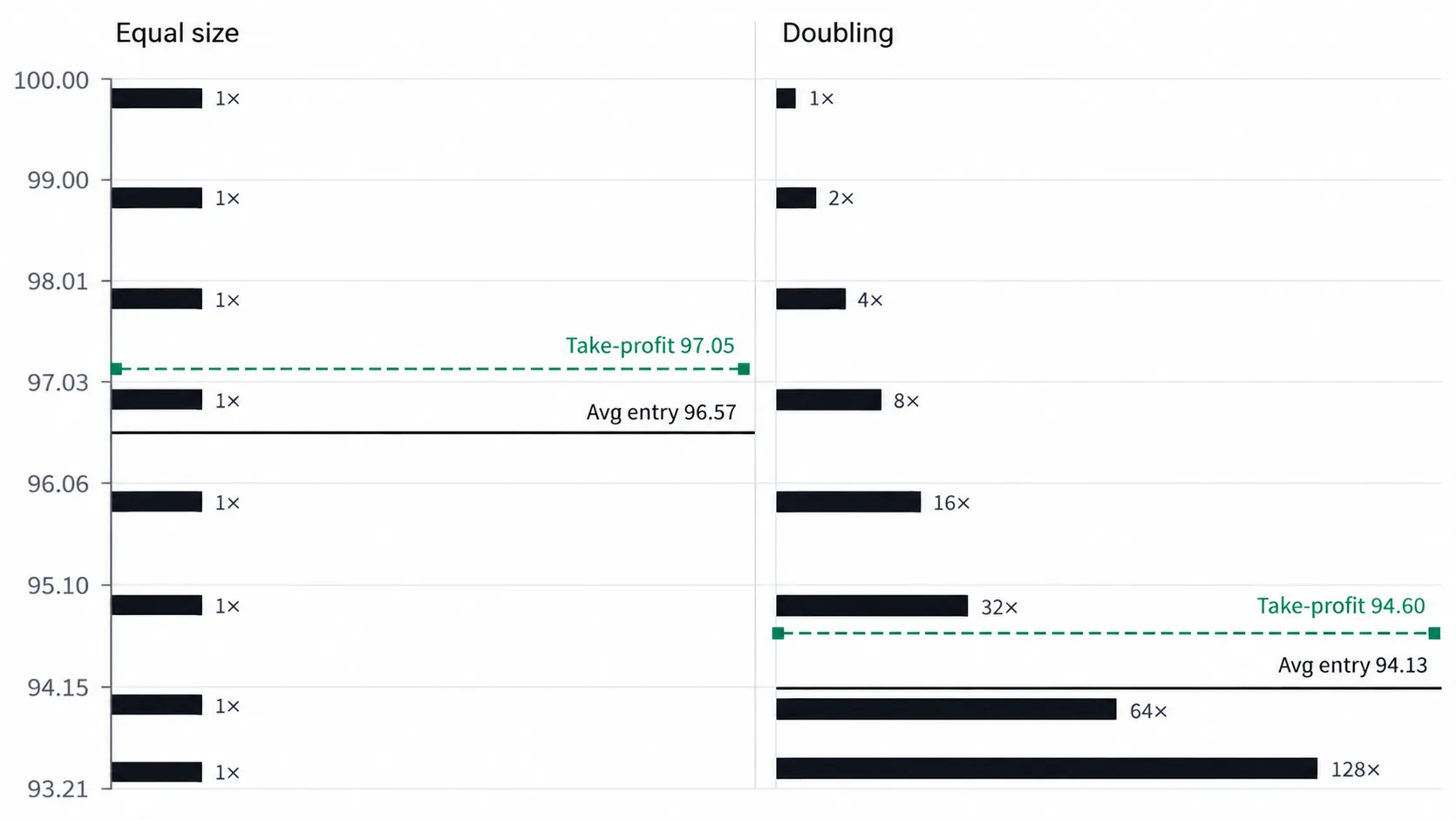
Here's a ladder with eight rungs, entries 1% apart starting at 100, and a take-profit 0.5% above the average. The first order is one unit.
Multiplier 2 (Martingale) | Multiplier 1 (DCA) | |
|---|---|---|
Rung sizes | 1, 2, 4, 8, 16, 32, 64, 128 | 1, 1, 1, 1, 1, 1, 1, 1 |
Total exposure | 255 × the first order | 8 × the first order |
Deepest entry | 93.21 | 93.21 |
Average entry | 94.13 | 96.57 |
Take-profit | 94.60 | 97.05 |
Bounce needed from the deepest rung | +1.5% | +4.1% |
Read the last two rows together. Doubling pulls the average entry down to within a point of the deepest rung, so a 1.5% bounce closes the ladder in profit. Equal sizing leaves the average three points higher, so the bounce has to be 4.1%, nearly three times as far.
Now read the second row. The doubling ladder bought that easier exit with 255 units of exposure against 8. If the first order was 1% of your balance, the doubling ladder at depth eight holds 255% of the balance in position value, and every further 1% drop costs about 2.5% of the balance. The DCA ladder holds 8% and loses about 0.08% per further 1% drop.
Martingale isn't a cleverer DCA. It's a bet that price bounces 1.5% before it falls another few percent, made with everything you have.
What you set, and what each setting does to the maths
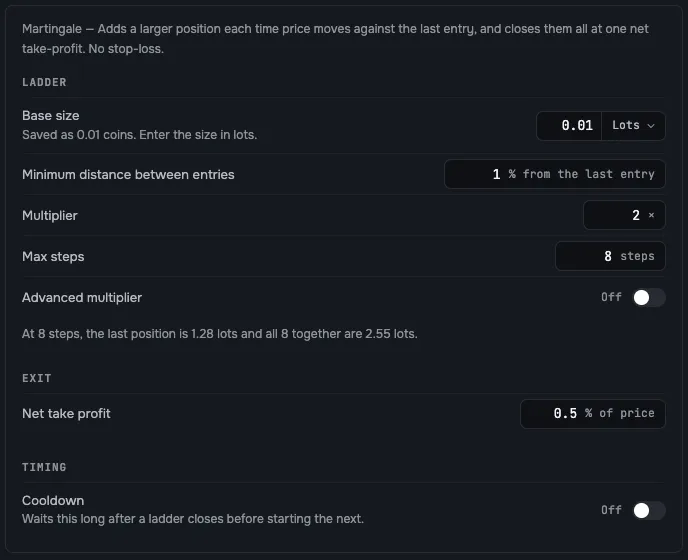
On a Vectorhelm Martingale strategy the ladder is defined by a short list, and each item changes the table above.
Direction. Long or short. A hedging account can run one of each on the same symbol, as two strategies.
First order size. A fixed amount or a percent of balance. Everything scales from this.
Multiplier. Each rung is the previous one times this. 1 is DCA. 2 is doubling. 1.5 is between: eight rungs total about 49 times the first order, with the average entry and the bounce landing between the two columns above.
Price step. The minimum distance between entries, in percent. Wider steps mean a deeper ladder covers more price for the same number of rungs, and a larger loss at the bottom.
Max steps. The number of rungs. This is where the exposure is decided. Doubling to eight rungs is 255×; to ten it's 1,023×.
Take-profit. Percent above the ladder's average entry, shared by every rung.
What starts the ladder. A TradingView alert, builder conditions, or always.
Cooldown. An optional pause before a new ladder can start after one closes.
When a risk limit fires. Keep the open ladder with its take-profit, or close it.
Three of those settings decide the exposure between them: first order size, multiplier and max steps. Vectorhelm doesn't work the ladder out for you, so do it before you launch, the way the table above does. Multiply the first order by the multiplier for each rung, add them up, and ask whether you'd hold that total at the deepest entry. If you wouldn't, lower max steps or the multiplier until you would. Execution modes covers how the four modes differ.
What the next alert does while a ladder is open
A Martingale strategy takes open signals in its direction, and nothing else. There's no close signal for a ladder; it closes at its take-profit.
An open signal while the ladder is already open adds a rung, but only if price has moved at least the step distance from the last entry. If it hasn't, the signal is recorded and skipped. That's what stops a script alerting on every bar from stacking five positions at the same price. Above max steps, the signal is refused and the refusal is logged with that reason.
If you close one rung by hand, the ladder carries on with the rest, and the take-profit is recomputed from the remaining average.
The limit that actually stops a ladder
This is the part that catches people, and it's worth being precise.
A daily loss limit counts closed trades. A ladder that's eight rungs deep and 15% underwater has closed nothing, so the daily loss limit sees nothing. It will not fire. The same is true of any tool that measures loss on realized P&L only.
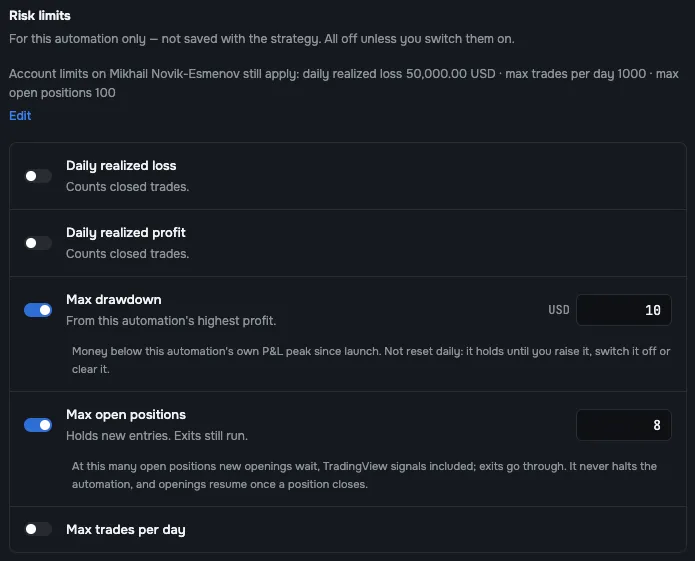
The limit that sees an open ladder is max drawdown, measured from peak equity, because equity includes the floating loss. Set at the strategy level, it stops that ladder at the depth you chose. Set at the account level, it stops everything on the account, which is the right call when the ladder is one of several strategies sharing a balance.
Depth is also capped twice: by the ladder's own max steps, and by the strategy's max open positions limit. The lower one wins. A ladder with max steps at ten and max open positions at six stops at six.
So the honest configuration for a Martingale strategy is three numbers, not one. Max steps sets how deep it can go. Max drawdown sets how much it can lose on the way, floating loss included. And the account's max drawdown sits above both, in case the ladder isn't the only thing having a bad day. The ladder has no stop-loss of its own. The limits are the stop.
The honest limitation
A ladder with a stop is a strategy with a stop. The appeal of Martingale is that it never takes the loss, and a max drawdown limit takes it for you, at the depth you set, on a day that might have bounced.
That's the trade. Without the limit, the ladder's loss is bounded only by the account, and the table above shows how fast that bound arrives at eight rungs doubling. With the limit, some ladders get closed that would have recovered. There's no setting that gives you the recovery without the risk, and any tool suggesting there is has left a row out of its table.
On a funded account, the arithmetic is worse than it looks here, because the firm's drawdown rule is measured on equity too. A doubling ladder that's 5% underwater on a 10% max drawdown rule has used half the account's life on one trade idea. Most firms also name martingale specifically in their rules, so read yours before the first ladder opens.
Before you run one
Work out the total exposure at max steps for your first order size and multiplier, and decide whether you'd hold that position at the deepest entry. If not, lower max steps or the multiplier until you would.
Set max drawdown on the strategy. Then set it on the account.
Run it on demo through at least one losing stretch, not just the bounce.
Join the waitlist. It's free, needs no card, and your invitation comes with a demo account running the full risk engine. Build a ladder from a TradingView alert, set the drawdown limit, and watch it close the ladder before it closes the account.
Vectorhelm is execution software. It runs the rules you define on accounts you own and control. Nothing here is trading advice. Martingale and DCA ladders can lose more than the first order many times over, and no configuration of risk limits prevents losses.
Opening soon
Automate it, with your limits built in.
Join the waitlist for free early access. Start on a demo account, then go live when you’re ready.
Join the waitlistStay informed
One email a month. Worth opening.
New articles and product news. No spam, unsubscribe any time.
A separate list from the early-access waitlist. How we handle your email.